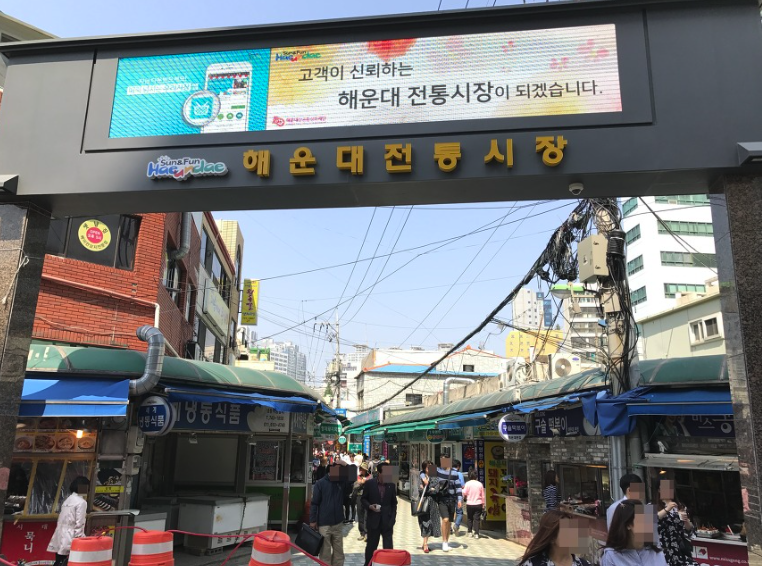
Yesterday in Busan, the sky remained heavy and grey all day before giving way to a torrential downpour in the evening. To keep my travel budget as tight as possible, I checked into a budget capsule hotel near Haeundae Beach. I had seriously considered staying at a traditional Korean bathhouse, a jjimjilbang, which is famous for being incredibly cheap. However, as a solo backpacker carrying a heavy pack loaded with my laptop, camera, and passport, sleeping in an open communal space felt too risky. In the end, I opted for a tiny, secure capsule bed for 22,000 KRW, which offered both privacy and peace of mind.
My feet were incredibly sore after spent the afternoon walking around the Haeundae beachfront and navigating the dense alleyways of the neighborhood. Another minor challenge of traveling in Korea is the absolute lack of public trash bins on the streets. I ended up carrying a greasy wooden skewer from an afternoon snack and a damp receipt in my jacket pocket for hours. By the time I crawled into my capsule, escaping the cold, damp air outside felt like pure bliss. But as soon as I settled in, a massive wave of hunger hit me. While Korean convenience store meals are legendary for their quality and low price, I wanted something authentic, piping hot, and spicy enough to clear my head. The thought of walking back out into the rain to order in broken Korean at a chaotic traditional market felt overwhelming. That was when I decided to see if I could order local food directly to my bed using only my phone, without speaking a single word of Korean.
How to Order Food on Baemin Without Knowing Korean
It is entirely possible to navigate Korea's complex food delivery network even if you do not speak a word of the language. For budget travelers and backpackers, mastering this process is a critical survival skill that saves money on expensive third-party concierge services. When I shared my delivery process in real-time with my university friends back in Germany, they could hardly believe how seamless it was. By utilizing just two mobile applications, I bypassed the language barrier and secured a hot meal directly to my accommodation.
Using Papago Image Translation to Decode Korean Menus
Korea’s primary delivery app, Baedalui Minjok (commonly known as Baemin), operates entirely in Korean without official English support. To solve this, I cross-referenced Google Maps and Naver Maps to locate a highly-rated tteokbokki (spicy rice cake) shop near my capsule hotel. Once I opened the restaurant's menu in the Baemin app, I took screenshots of the food listings. I then opened the Naver Papago translation app and imported the screenshots into its image translation tool.
The translation tool instantly converted the Korean characters into highly legible English and German text. Popular menu items like 'Sinjeon Tteokbokki', 'Assorted Fried Sides', and 'Sinjeon Cheese Gimbap' became immediately recognizable. While a few culinary terms translated slightly awkwardly, the overall pricing and ingredient structures were perfectly clear. Adding the items to my virtual cart felt like a massive victory, proving that modern travel technology can easily bridge significant language gaps.
Solving Payment Errors for Foreigners on Korean Delivery Apps
Choosing the food is relatively straightforward, but the payment stage is where most international travelers get stuck. The majority of online payment gateways in South Korea require local phone number verification or a domestic bank account. For a short-term foreign traveler, this security wall is almost impossible to bypass using standard international credit cards. However, there is an efficient workaround that solves this issue without requiring local credentials.
Using TravelWallet Card to Bypass Identity Verification on Baemin
The TravelWallet prepaid card, a popular financial tool for budget travel across Asia, provided the solution. The card links directly to my European bank account, allowing me to exchange Euros for Korean Won (KRW) instantly within the app. The primary benefit of this card is that it charges zero international transaction fees, making it highly efficient for managing a strict daily travel budget.
After calculating my total order value of 15,000 KRW, I exchanged the exact amount inside the TravelWallet app. This precise budgeting method prevents accidental overspending. In the Baemin checkout screen, I selected 'Other Credit Cards' as my payment method, selected 'Shinhan Card' (which processes TravelWallet transactions), and entered my card details. The payment went through immediately without requesting any local phone verification or residential registration numbers. Keeping a stable Wi-Fi connection or a reliable local eSIM active during this process is crucial to avoid transaction timeouts.
Korean Food Delivery Costs vs Europe: A Budget Traveler Perspective
The delivery fee on my receipt was 3,000 KRW, which is roughly equivalent to 2 Euros. Comparing this to the delivery fees on European platforms like Lieferando in Germany highlights a massive difference in affordability. In major German cities, delivery fees often start at 5 Euros, and orders frequently take over an hour to arrive. Additionally, tipping culture makes ordering delivery an expensive luxury that most students and backpackers avoid.
In contrast, the efficiency of the Korean logistics network is remarkable. Despite the heavy rainstorm, my food arrived at my accommodation in under 30 minutes for a very low delivery fee. The speed and cost-effectiveness of this system make food delivery a highly viable option for budget-conscious travelers in Korea.
What to Order at Sinjeon Tteokbokki: The Perfect Spicy Combination
Exactly 25 minutes after placing the order, I received a notification that the food had been dropped off in the capsule hotel lobby. After a brief issue with my room key card at the lobby entrance, which was resolved with the help of a friendly hotel guest, I retrieved my bag of hot food. Opening the sealed plastic containers inside my capsule immediately filled the small space with a powerful aroma of roasted pepper and sweet chili.
The Spicy Kick: Sinjeon Original Tteokbokki and Rice Cakes
The main dish was a deep red, sauce-heavy portion of tteokbokki. The first bite delivered a sharp kick of black pepper and highly concentrated chili heat. Unlike the mild, adjusted spicy foods often served in Europe, this was an uncompromising, authentic local spice level that immediately cleared my sinuses. Beneath the heat, there was a distinct sweet and savory base that kept the dish balanced. The texture of the chewable cylinder-shaped wheat cakes (mil-tteok) was incredibly soft and elastic, offering a completely different mouthfeel compared to the potatoes or pasta common in Western cuisine.
Balancing the Heat: Deep-Fried Fish Cakes and Cheese Gimbap
To balance the intense spice of the rice cakes, I ordered deep-fried fish cakes and fried dumplings. Dipping these crispy, savory sides directly into the thick tteokbokki sauce allowed the oil from the fried food to cut through the sharp chili burn. The real highlight, however, was the Sinjeon Cheese Gimbap. Filled with rice seasoned in spicy sauce and packed with a thick layer of melted mozzarella cheese, the savory cheese acted as a perfect neutralizer for my palate, making the spice level much more manageable.
Busan Solo Travel Budget: Cheap Eats Delivery Cost Breakdown
The entire ordering process was completed digitally without using any physical cash. The transaction breakdown demonstrates how affordable a high-volume local meal can be when traveling through South Korea:
- Sinjeon Tteokbokki (1 serving): ₩3,500
- Assorted Fried Sides (1 set): ₩4,500
- Sinjeon Cheese Gimbap (1 roll): ₩4,000
- Delivery Fee: ₩3,000
- Total Expenditure: ₩15,000 (Approx. €10.20)
In Germany, 10 Euros would barely cover a basic fast-food meal via a delivery app once service fees are included. In Busan, that same budget secured a multi-item feast delivered directly to my door in the middle of a rainstorm. Overcoming the local payment system and language barrier to enjoy a hot, authentic meal in my capsule hotel remains one of my most satisfying achievements of this trip.